
It's Thanksgiving week, which means that sometime in the next few days, someone at a table may ask everyone to say what they're grateful for.
You'll probably say your family. Your partner will probably say the same. Everyone will nod, the potatoes will get passed, and that will be that.
And yet I'd guess that one of you, maybe both, will be sitting at that table feeling quietly unseen. Because being on someone's gratitude list is not the same as feeling appreciated by them.
I hear it in my office every week. "I do so much, and nobody notices." "The only time I hear about what I do is when I do it wrong." The partner sitting next to them is almost always surprised. "Of course I appreciate you. You know that."
Do they, though?
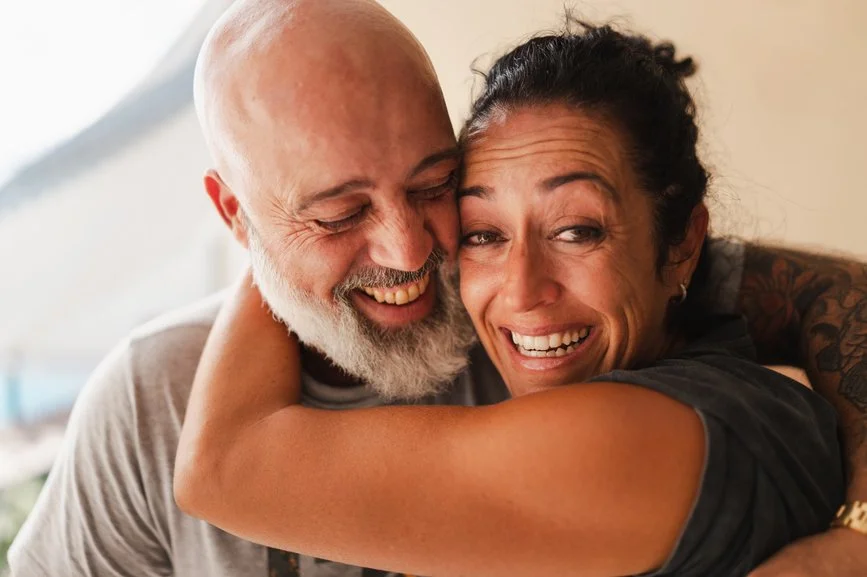
"Thanks" Isn't the Same as Being Seen
Most couples I work with are not ungrateful people. They say thanks. They say it on the way out the door and across the kitchen: thanks for dinner, thanks for grabbing the kids, thanks, babe.
The trouble is that a generic thank-you is a receipt. It confirms that something was received. It doesn't tell your partner that you saw what it cost them.
Real appreciation has detail in it. It names what your partner did, what it took, and what it meant to you. Compare "Thanks for dinner" with "You worked all day and then you still made the soup I like because you knew I'd had a rough week. That really got to me."
The first one is polite. The second one tells your partner that their effort landed somewhere. That somebody is paying attention to their life.
Underneath almost every "you never appreciate me" is a softer sentence: I need to know that I matter to you, and that what I give doesn't disappear. In Emotionally Focused Therapy we talk about partners needing each other to be accessible, responsive and engaged. Appreciation is one of the simplest ways to say, I'm here, I see you, and you matter to me.
Why the Good Stuff Goes Invisible
If appreciation is so simple, why does it dry up?
Partly because we're built to notice problems. The dishwasher loaded "wrong" jumps out at you. The dishwasher loaded at all doesn't register. What works becomes background, and what doesn't work becomes the conversation.
Partly because of time. In the beginning, everything your partner did was new, so you noticed it. Ten years in, the fact that they handle the insurance paperwork, remember your mother's birthday, or warm up the car in January has become the way things are. Expected things don't get thanked.
And partly because of scorekeeping. When you're tired and stretched, it's easy to feel like the one who gives more. From there, appreciating your partner can feel like giving up ground. Why should I thank them for doing the laundry when I did four other things today and nobody thanked me?
So you both wait. Each of you is hungry for acknowledgment, and each of you is holding it back until the other goes first. I've sat with many couples in exactly that standoff. Neither person is being selfish. They're both running on empty.

The Ratio That Predicts How Your Fights Go
John Gottman found that in relationships that last, there are roughly five positive interactions for every negative one during conflict. Five to one. In relationships that are in trouble, that ratio drops close to one to one.
I want to tell you why that matters, because it isn't about being nice for its own sake.
Appreciation is what gives you the benefit of the doubt. When your partner feels valued day to day, a sharp comment from you gets read as "they're having a hard day." When your partner feels invisible, the same comment gets read as "here's more proof that I can't do anything right." It's the same sentence, and it starts two very different fights.
It also works against contempt, which is the most damaging of what Gottman called the Four Horsemen. Contempt grows in a relationship where each partner has become a list of the other's failings. The antidote is a habit of noticing what's right, out loud. I've written more about those patterns and how to stop them.
So if you want your hard conversations to go better, one of the most useful things you can do has nothing to do with the hard conversations. It's what you say on an ordinary Tuesday.
How to Appreciate So It Lands
Here's what I coach couples to do.
Be specific. Name the thing. Not "you're a great dad" but "I watched you get down on the floor with her and build that whole marble track when I know you were exhausted."
Name the effort, not only the outcome. "I know calling the school meant rearranging your whole morning." Your partner wants to know you saw what it took.
Say what it meant to you. "When you handled that, I felt like I could breathe." This is the part most of us skip, and it's the part that goes deepest. It tells your partner what kind of difference they make in your life.
Appreciate who they are, not only what they do. "I love how you never give up on people." Tasks can feel like a job review. Character feels like being known.
And say it when it's happening. Appreciation saved up for an anniversary card is worth less than appreciation delivered while the dish towel is still in their hand.
These are micro-moves: small, repeatable, almost embarrassingly simple. They are also the kind of thing that changes the temperature of a home.

When It Feels Awkward or Unfair
I'll be honest about two things that get in the way.
The first is awkwardness. If the two of you haven't talked like this in a long time, the first few attempts may feel stiff. Your partner might even be suspicious. That's okay. Do it anyway. Sincerity that's a little clumsy still counts, and it gets easier quickly.
The second is resentment. If you've been feeling unappreciated for years, being told to appreciate your partner can feel like one more thing on your plate. I understand that. I'd ask you to consider that someone has to go first, and that going first is not losing. It's often the thing that lets your partner finally relax enough to see you, too.
And if you're on the receiving end, let it in. Many of us deflect: "Oh, it was nothing." When your partner offers appreciation, that's a bid for connection. Take it. "Thank you for noticing. That means a lot" is plenty. I've written about those small bids and why they matter so much.
An Experiment for This Week
Thanksgiving comes with a built-in prompt, so let's use it.
Sometime this week, away from the table and the relatives, tell your partner three specific things you appreciate about them. One thing they did recently. One thing they do all the time that you've stopped mentioning. One thing about who they are.
Then keep going after the holiday. One specific appreciation a day through the end of the year. It takes about fifteen seconds. Notice what happens to the mood in your house, and notice what happens to your own attention. When you go looking for what's right, you start finding more of it.
If the two of you have gone so long without feeling valued that this seems out of reach, that's something we can work on together. You can schedule a free video consultation and I'd be glad to help you find your way back to each other.
Your partner doesn't need a speech at the Thanksgiving table. They need to know that you see them. Tell them what you see.